At the GSA EEF 2026, I had the opportunity to ask the European semiconductor executives what they think — and why it matters
At the GSA European Executive Forum in Munich on June 10–11, 2026, I had the privilege of moderating the live polling sessions across the conference, inspired by the topics addressed by the different keynotes and panels. Using a voting app on their phones, 200+ people answered nine questions on the most consequential issues facing the European semiconductor industry. The audience was 90% European, overwhelmingly working in semiconductor design, EDA, foundry, and systems. These are the people who actually make chips — or rather, make the decisions about how European companies make chips. Around 60% of respondents said they work at large corporations or public companies, 30% in SMEs and only 10% at small companies or startups — which may reflect the GSA European population but may also be a reasonable representation of the European ecosystem, with a concentration of larger companies and fewer startups.
First, a word about polls
A live conference poll is not a scientific survey. I designed the questions to create tension, and the 3–4 possible answers to capture the big picture rather than allow every possible nuance. Such a live poll is a “pulse check” — useful precisely because it is taken in real time, without time for people to align with their employer’s public position. This is also not necessarily the crowd-wisdom view of what will eventually turn out as the future, but rather what these leaders believe should happen and what they wake up every morning and work to make happen.
Just to illustrate this point: To test the system and get people engaged, my first warm-up question was “Who do you think will win the FIFA World Cup?”, an event that kicked off almost the same day as the EEF. Of the European national teams offered as options, 27% chose France and 25% Germany. Spain, which received just 13% of the vote, was the eventual tournament champion.
The pattern is not hard to read. The conference was held in Munich. Germans and French were heavily represented in the audience. I do not think this invalidates the poll findings. The respondents are industry insiders, and their professional judgment on these questions is genuine and informed. But it is a useful reminder that even expert opinion has a home-team dimension.
With that caveat stated, here is what the pulse said.
1. European semiconductor professionals are net AI optimists
Where we are in the hype cycle with AI is a question being debated in various forums. So, I wanted to get the audience’s personal opinion on this. After hosting a panel on AI at GSA EEF 2025 where three senior executives basically all agreed that “the train left the station” for AI in Europe, the poll results actually surprised me: 57% said we’re “just getting started” with AI — the economic impact is still massively underestimated. Only 14% saw a dangerous bubble. The remaining 29% believed we are approaching peak.
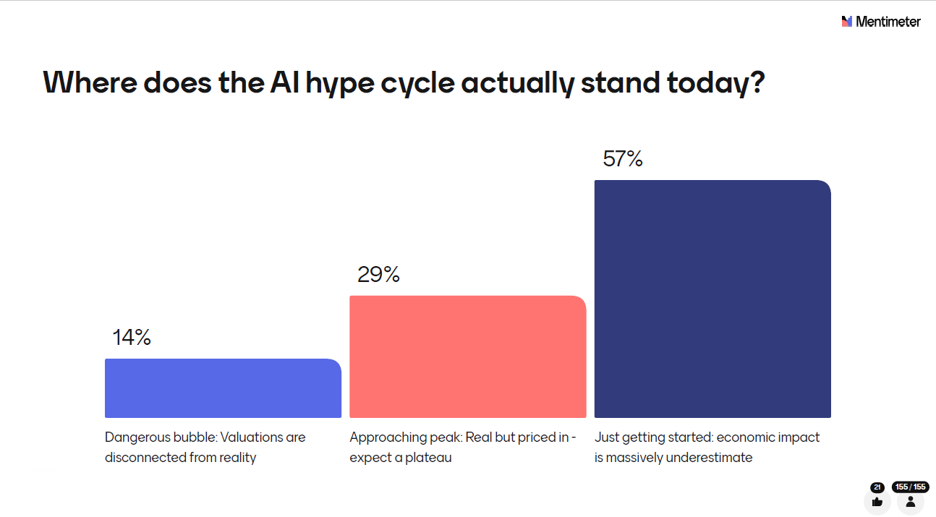
The people who actually build the silicon that runs AI believe, by a clear majority, that we have barely started.
True, this question was not specifically about Europe’s own position in the AI space — but still, I was surprised by the overall positive sentiment.
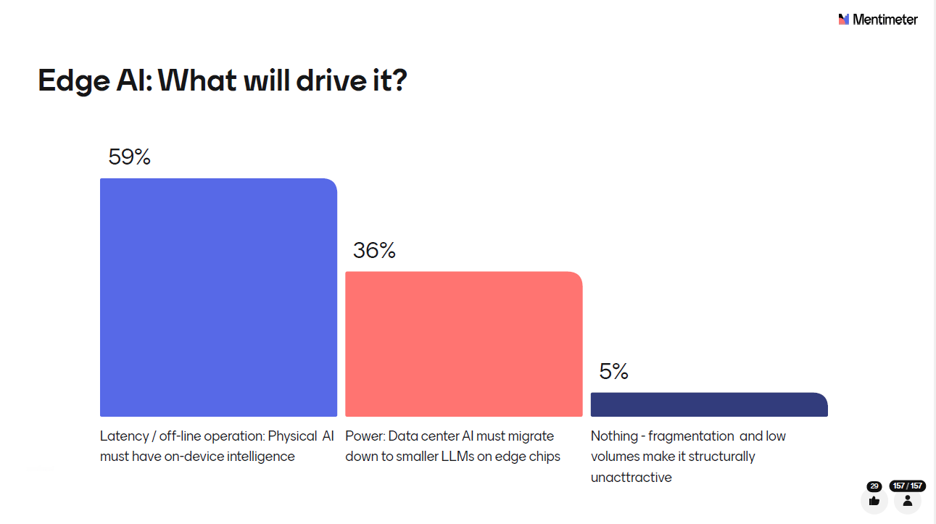
The Edge AI question reinforced the picture: 95% of respondents believe Edge AI will happen — they only disagreed on the mechanism. 59% argued the driver is physical necessity: autonomous systems, robots, and vehicles cannot tolerate cloud round-trip latency. 36% said data center AI must migrate downward as models shrink and chip efficiency improves, to fit a tighter power envelope. Only 5% were skeptical. In a room this experienced, a single-digit rate of skeptics on a technology thesis is as close to consensus as you get.
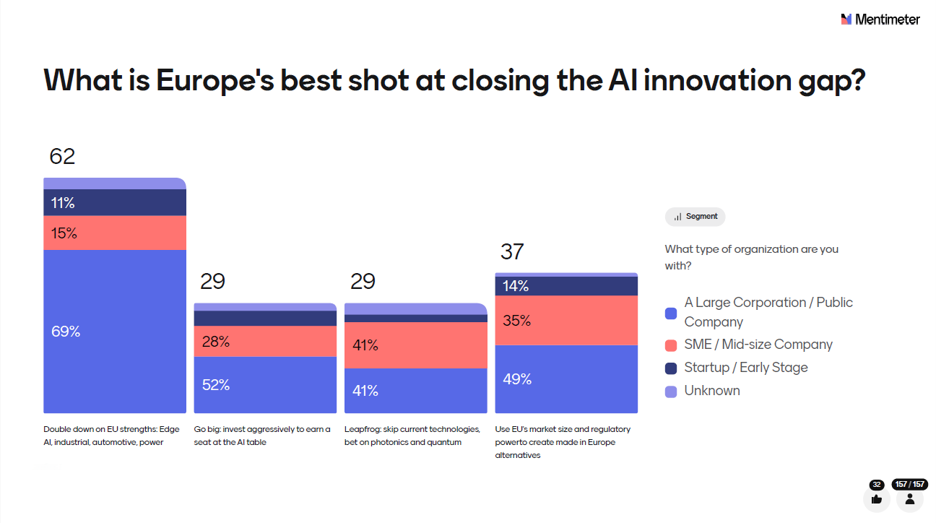
When asked specifically about Europe’s best shot in the AI space, the majority supported “doubling down” on European strengths in automotive and industrial. This probably also reflects where European executives — primarily at the big European companies such as Infineon, ST, and NXP — believe their companies can play in the AI game: not at the data-center core, but with smaller, low-power, edge devices.
2. Europe and the geopolitical split
Most of the sovereignty debate is between the US and China, but Europe is often caught in the middle.
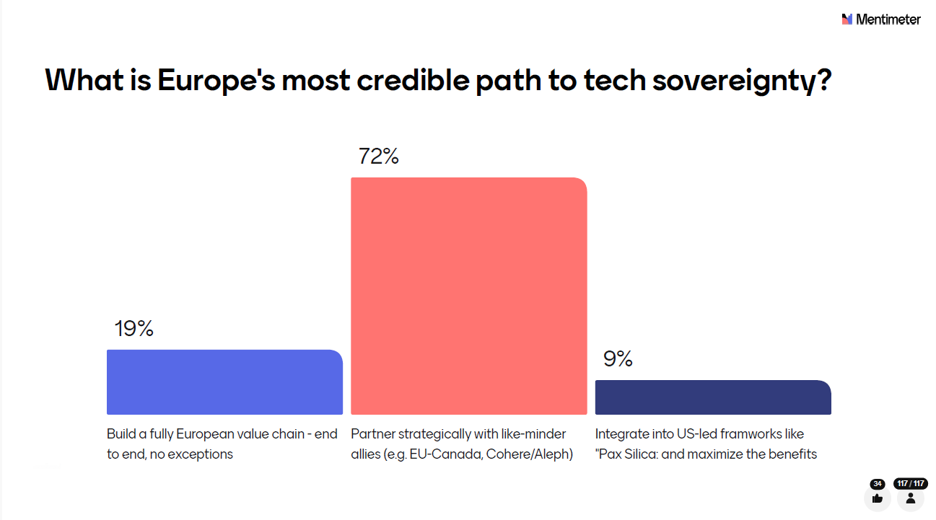
Asked about Europe’s most credible path to tech sovereignty, 72% chose to “partner strategically with like-minded allies” — such as the collaboration between German Cohere and Canadian Aleph. In contrast, around 20% supported investing to build full European autonomy. Aligning with the US and integrating into frameworks like Pax Silica drew only single-digit support.
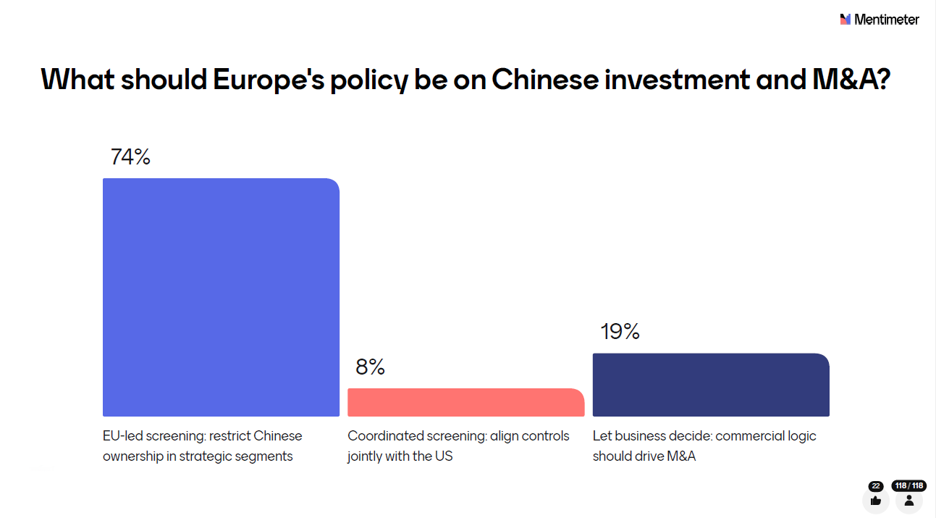
I went ahead and asked a specific provocative question about China acquiring European semiconductor strategic assets, just after a presentation by the Chief Strategy Officer at Nexperia — a Dutch company acquired by Chinese Wingtech Technology, a transaction that sparked intense debate. 74% supported EU-led screening of Chinese investment in such cases, decided independently in Brussels and not coordinated with Washington. Only 8% wanted to align controls jointly with the US. Roughly 20% preferred less politics and more business rationale.
3. EU Chips Act 2.0 — the jury is still out
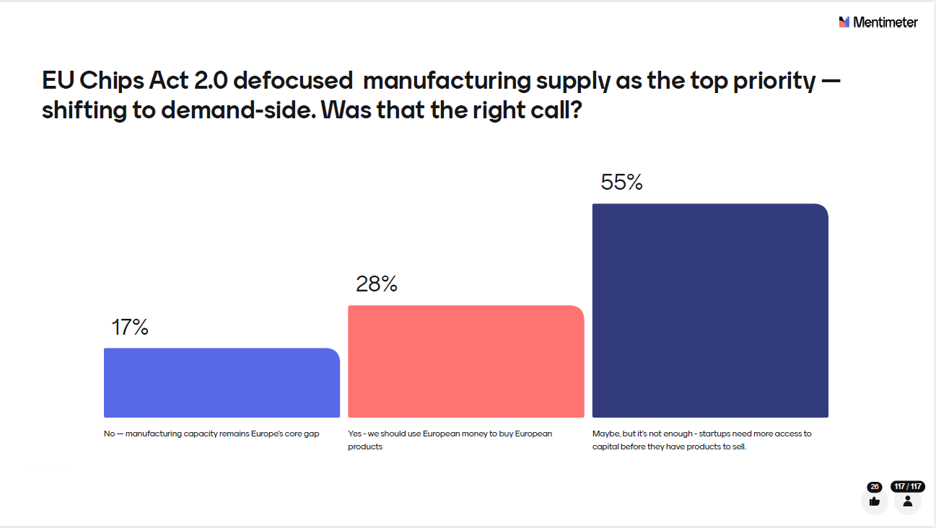
The EU Chips Act 2.0 was published on June 3rd — one week before the conference — dropping front-end manufacturing as the top priority and pivoting toward demand-side measures, R&D, and a €120 billion investment target. I wanted to ask the room for their opinion on this shift.
Only 28% fully endorsed the Commission’s policy. 55% said the direction was right but the scale insufficient, while 17% rejected the direction entirely, arguing that advanced manufacturing capacity remains Europe’s core gap regardless of what any policy document says.
What has been published is still a recommendation document, not a detailed plan. But given the mixed results of EU Chips Act 1.0 that I have reviewed on my Substack newsletter before, it is only natural that more than half of the respondents are sceptical — with a sizable portion outright contrarian.
Meanwhile, when asked to state in one word what the continent’s sovereignty will be built on, the resulting word cloud produced something worth noting: alongside “talent,” “trust,” “partnerships,” and “manufacturing,” two quieter answers surfaced — “wishful thinking” and “a myth.” One vote each. Someone in that room, asked what Europe’s semiconductor sovereignty will be built on, typed the word “myth” into their phone. That is the honest undercurrent beneath all the optimism.
4. Europe’s automotive semiconductor industry
For years, the automotive industry has been a cornerstone of the European industry, encompassing OEMs, Tier-1 suppliers, and semiconductor companies. The state of this industry is also always a major topic at the EEF. So it was only natural for me to ask the audience about their feelings towards European automotive prospects. Their answer was perhaps the most sobering in the poll: Asked whether the European automotive semiconductor industry has a viable future, only 9% answered “absolutely!” The majority — 63% — said yes, but only by moving significantly faster. And 28% said the wave has already been missed: the EV transition handed the game to Tesla and Chinese OEMs before European traditional players could adapt.
The 28% who believe the wave has passed are not American analysts (or Chinese for that matter) looking in from across the ocean. These are industry insiders — many of whom may work at or supply companies like Infineon, ST, NXP, Bosch, Continental, or European OEMs.
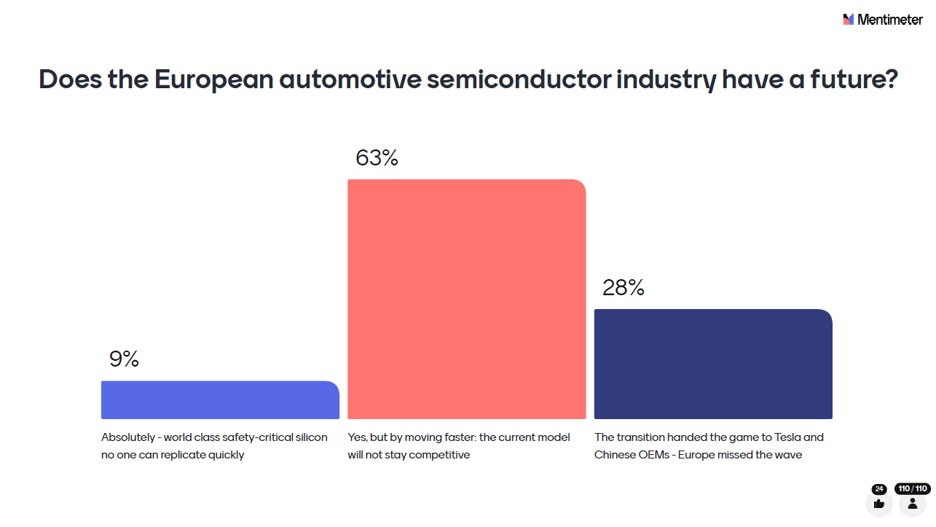
When nearly a third of the room privately concludes that their own sector has missed the critical transition, that is worth more than any external forecast.
5. What AI will impact, and what not
As one might expect, the impact of AI was — as in most conferences nowadays — a topic of much interest.
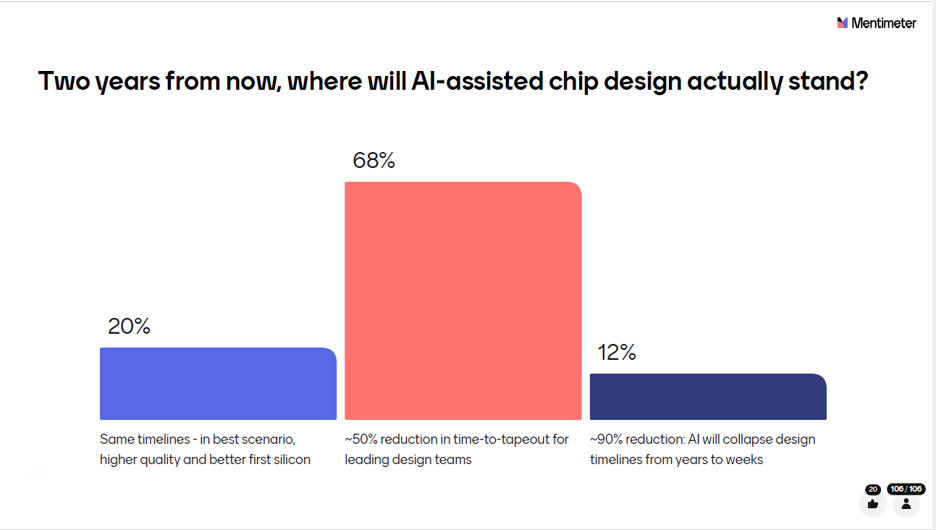
Following presentations about the role of AI in various phases of chip design, I asked the audience what they believe the real impact of artificial intelligence will be on the design process two years from now. This is a question I’ve repeated on many occasions, as – in my view – the real impact of AI should not be in accelerating specific tasks, but in completely transforming how certain things are done.
The vast majority voted for a ~50% reduction in effort — perhaps a pragmatic middle ground between a complete game-changer scenario (90% reduction) and the “not much change” view, which still drew 20% of skeptics.
I ended the polling session with an open question: In one word, what will AI never replace in us?
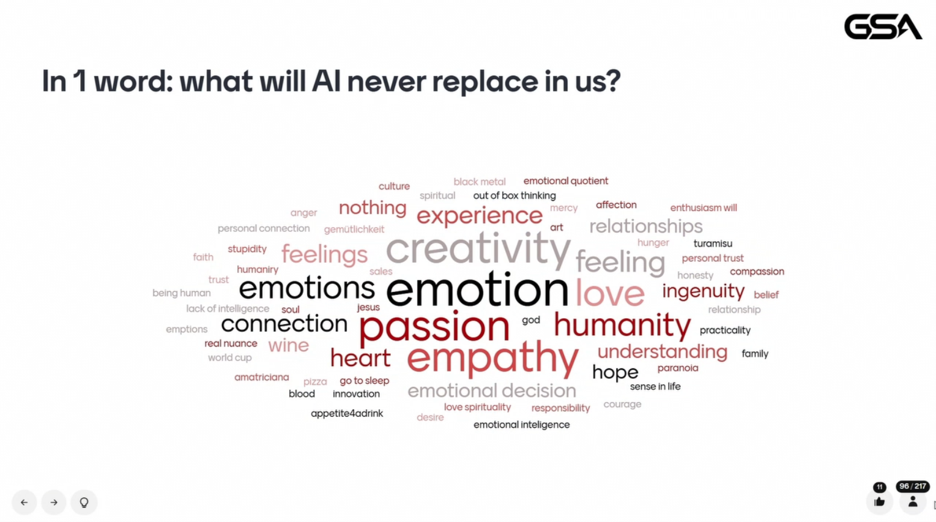
It is heartening that, with all the debate about technology, people still believe that what makes us inherently human is reflected in words such as emotion (16 votes), passion (11), creativity (11), and empathy (10). Judgment, curiosity, trust, purpose, and accountability followed close behind. And then, in the tail of the distribution: wine (2 votes), tiramisu, pizza, Gemütlichkeit (cosiness in German), beers — one each. Someone typed “World Cup.” A room of semiconductor executives, asked to name the irreducible core of human experience, reached first for moral and cognitive virtues, and second for food and football. I find this genuinely encouraging.
What the data says, taken together
Earlier in the day, while closing one of the panels, the moderator said: “It’s good to see that we all believe in…” and stated an opinion on something. I personally don’t like being told what I believe, and certainly not when we dare to say what 200+ accomplished and opinionated leaders believe. But through this polling exercise, I think we can summarize the “pulse” of this 90%-European audience at a semiconductor conference in Munich in June 2026:
We are optimists about AI, not because we are naive about the hype but because we work with the technology and believe the demand is real.
We want European sovereignty, and we want it built through trusted partnerships, not walls.
We want the EU to screen Chinese investment independently and firmly.
We are cautiously supportive of Chips Act 2.0 but unconvinced the scale matches the ambition.
We are deeply worried about the future of the European automotive industry.
We believe AI will transform our work — but not everything, and not overnight.
More than anything, we think AI will not replace what makes us human.
A room that believes in European sovereignty and in Gemütlichkeit, wine, beer, and tiramisu is not a room that has given up. That may be the most important finding of all.

About the Author
Moshe Zalcberg is Managing Partner Israel at Silicon Catalyst, the world’s leading semiconductor-focused accelerator, and Chairman of Veriest Solutions, an international chip design services company with over 150 engineers, which he led as CEO for 11 years. A frequent speaker at industry conferences, he brings more than 30 years of experience in the semiconductor and design automation industries. He also authors Advanced Notes, a Substack newsletter on technology, business, and innovation. Previously, Moshe spent over 12 years at Cadence Design Systems in roles including General Manager Israel and European Director of Professional Services, before joining Presto Engineering as GM Israel and VP of Business Development. He holds a BSc in Electrical Engineering from the Technion – Israel Institute of Technology, and an MSc in Electronics and an MBA from Tel Aviv University.